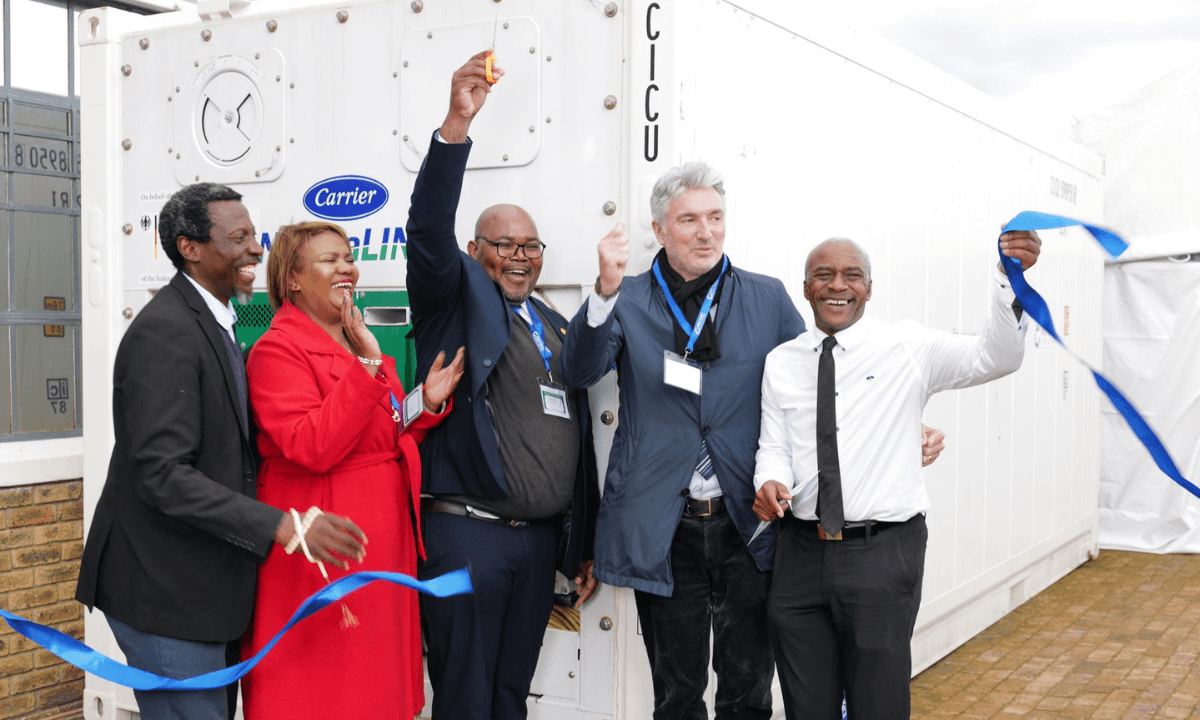
The German Society for International Cooperation (GIZ) has handed over a new CO2 (R744) training reefer to West Coast TVET College’s Refrigeration and Air-Conditioning Center in Cape Town.
The refrigerated container will be used to train students, technicians and community members on CO2-based refrigeration technologies and help South Africa’s transition to natural refrigerants. The initiative is designed to expand access to hands-on R744 training in the country and support the need for skilled technicians. The unit was provided through a partnership between South Africa’s Department of Forestry, Fisheries and the Environment and the GIZ.
The unit is a NaturaLine Container developed by Carrier Transicold and commercially launched in 2013. At an ambient temperature of 38°C (100°F), its cooling capacity ranges from 3.6kW (1.02TR) at −40°C (−40°F) to 9.4kW (2.6TR) at 2°C (35°F).
Building natural refrigerants expertise: The handover coincided with five days of CO2 refrigeration training completed by 13 participants.
- The training was part of a series of specialized courses conducted by the Air-Conditioning and Refrigeration Academy at the West Coast TVET College.
- South Africa held its first training dedicated to CO2-based refrigerated containers in Durban in July 2025.
- In addition, two five-day CO2 courses were completed by 30 technicians in October and November 2025.
Work at sea: This is not the GIZ’s first initiative aimed at reducing the environmental impact of refrigeration in the maritime sector.
- In April 2026, the Greener Reefer Transition Alliance and the GIZ announced an emissions and cost simulator that compares refrigerant use in maritime containers. The tool assesses their environmental impact and then translates it into monetary value.
- Thermo King and the GIZ have developed a direct expansion propane (R290) prototype reefer with a maximum 2kg charge. The unit provides 6.4kW (1.8TR) cooling capacity at −18°C (−0.4°F) in an ambient temperature of 38°C (100°F). Its refrigerated range is from −30 to 30°C (−22 to 86°F) in outside temperatures between −30 and 50°C (−22 and 122°F).
GIZ’s global training: Beyond its work on technical projects, GIZ also supports the wider adoption of natural refrigerants through educational programs and capacity building.
- Together with Brazil’s Ministry of Environment and Climate Change, the GIZ delivered training to 700 HVAC&R technicians in the safe handling of flammable refrigerants in split air-conditioning systems in December 2025. The training, part of Brazil’s HCFC phase-out management plan, was designed to strengthen the country’s adoption of natural refrigerants.
- In October 2025, the GIZ organized a training for 14 technicians in Maintal, Germany, which focused on the application of propane and CO2.
Quotable: “The CO2 training reefer is an important milestone in our shared efforts to advance sustainable refrigeration and strengthen technical skills in South Africa,” said a representative of the German Embassy at the handover ceremony.


